
Finding Recent Ascension Parish Arrests
The official starting point is the Ascension Parish Sheriff's Office New World Inmate Inquiry. One portal gathers the whole parish booking picture. APSO bookings appear there. So do arrests by Gonzales Police, Donaldsonville Police, and Sorrento Police. Other agencies feed the same system. Their arrests show up once booked into Ascension Parish Jail. It works as a live custody roster rather than a separate daily arrest feed.
| Time window | Best route | What it can answer | Important limit |
|---|---|---|---|
| Same day | Arrests Last 24 Hours | How to check a booking believed to have happened today or overnight | APSO does not publish a verified rolling 24-hour feed |
| Several days | Police Blotter | How to reconstruct a multi-day booking picture from official and dated sources | News and republication pages are selective or unofficial |
| Current custody | APSO inmate inquiry | Custody, housing, identifiers, photo, and booking-linked fields | Release or transfer can change the result |
| Ongoing status | VINELink Custody Check | Search and notification after an arrest | VINE is not the court disposition |
APSO publishes no daily booking archive. The two window pages teach search methods instead of pretending an official feed exists. Timing matters as well. A person can already be under arrest while fingerprinting, classification, and data entry are still underway. When a custody question is urgent, recheck the official roster and call Corrections rather than waiting on the portal.
Booked and in custody are related but different. Booking is the jail's intake process, where staff create the event record and identification fields. In custody marks present status at refresh. A release or transfer can change that status. A correction can too. Yet none of it erases the fact that intake occurred. So note the booking number and date, since a screenshot or a name alone is weak evidence: the web display changes, and two people can share similar identifiers.
A person can also move between systems. Parish booking usually comes first for local arrests. LA VINE can then supply custody monitoring. The court docket carries the legal case itself. A later state sentence shifts the search to DPS&C, and a federal hold or immigration custody requires a different locator. Keep each source's number close, because using the wrong one is a common reason a valid record seems to vanish.
When Does a New Arrest Appear?
APSO promises no public posting interval. Someone arrested last night may appear only after intake is complete. The booking date can differ from both the arrest time and the publication time. Search the official roster by name. Then narrow with the custody and date controls. Recheck later if intake may still be processing. The detailed same-day arrest guide explains how to confirm an overnight booking without treating an empty search as proof that no arrest occurred.
For a known person, the VINELink custody check adds statewide status and optional notification. It works best after a record is found. It does not replace APSO's booking fields or the court docket.
An empty roster result calls for testing assumptions in order. First confirm the spelling. Consider whether the person may use another name. Expand the booking-date range. Remove the current-custody filter. Then check whether the arresting agency actually booked the person into Ascension Parish Jail, and call the corrections line for a current-status question. A past booking points to a focused public-record request. An active case points to the correct clerk. Each step answers a different question, so repeating one name search across unofficial sites is less reliable than following the custody state.
Search the Ascension Parish Jail Roster
The portal accepts a last name, first name, subject number, or booking number. Custody, date-range, and housing-facility controls help narrow things down. A booking or subject number beats a name. Similar names get confused. One person can also have multiple bookings. Results may show a booking photograph, custody status, scheduled release date, demographic descriptors, and housing, while detail pages can add charges, bond rows, arresting agency, court date, courtroom, docket, disposition, and sentence fields. The interface carries no published refresh promise or persistence period. Identifier-plus-date searching is more dependable than a name-only scan, though it cannot create a complete archive.
| Search field | Use it when | Caution |
|---|---|---|
| Name | No identifier is available | Match DOB and booking information before assuming identity |
| Subject number | Following the person within APSO's system | Keep it distinct from a court or DOC number |
| Booking number | Following one intake event | A person can have more than one booking |
| Custody filter | Checking who is presently held | A released or transferred person may no longer appear |
| Date range | Narrowing newer entries | Booking time can differ from arrest time |
- Open the APSO inmate inquiry and try the most specific identifier available.
- Open the matching detail record and save its booking number, subject number, arresting agency, and court identifiers separately.
- Read “charge description” as an charge and look to the disposition fields or court record for the outcome.
- If the entry is absent, consider intake delay, release, transfer, or spelling before contacting APSO Corrections at 225-473-8674.
The official APSO search screen shows how these filters are presented.
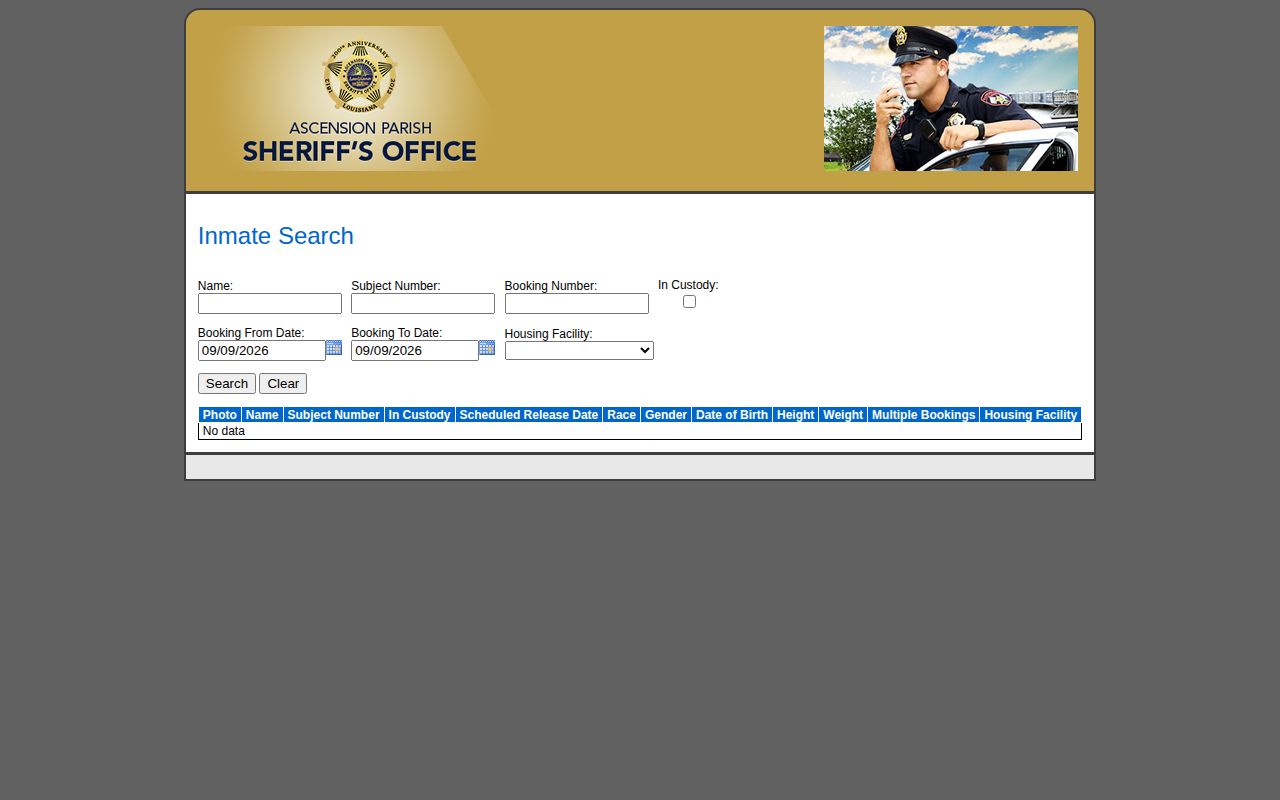
The image shows the official search interface itself. It is not a photo gallery. APSO offers no jail-roster app; its APSO Tips app handles tip submission, not booking lookup.
Ascension Arrest Tips Are Not Feeds
APSO Tips serves one purpose. The sheriff's Facebook page and the News & Events section each do a different job. The app exists to gather public-safety tips from residents. So does the text route. Social posts and news items cover only the events the agency chooses to share. None of them works as a same-day Ascension Parish arrest feed. For bookings, the roster still answers best.
The distinction matters most when a big agency post appears near a booking record. A post going up early or late reflects a communications choice. It is not a custody schedule. The roster is the official record of who is in the jail. The court file is where a charge finally lands.
News & Events can add real color to a major arrest. The same goes for a public warning or an open investigation. Still, a quiet news page never means the jail took no bookings that day. An APSO Tips alert does not prove the named person is in custody either. Know each channel's purpose before you conclude anything. Tips bring the agency information. News explains selected events. The roster reports jail data, and the court tracks the charge.
Where Ascension Arrest Information Is Published
Start every lookup with the official source. Secondary publishers can point you toward a date or an article, yet they lag releases, keep old photographs, duplicate bookings, and sometimes attach the wrong agency name. Treat them strictly as discovery aids. Anything they show belongs back in APSO or the court record for confirmation.
| Channel | Photos? | Status | How to use it |
|---|---|---|---|
| APSO roster | Yes, when supplied | Official | Current custody and booking-linked detail |
| APSO News & Events | Sometimes | Official, selective | Agency announcements, not a complete blotter |
| WAFB, WBRZ, Weekly Citizen | Sometimes | Independent news | Selected stories, not every booking |
| RecentlyBooked, Busted Newspaper | Often | Unofficial | Cross-check dates only; verify officially |
| Arrests.org, Mugshots.zone, Mugshots.com | Often | Unofficial | May be stale, incomplete, or duplicated |
The WAFB local-news index illustrates the article-based channel.
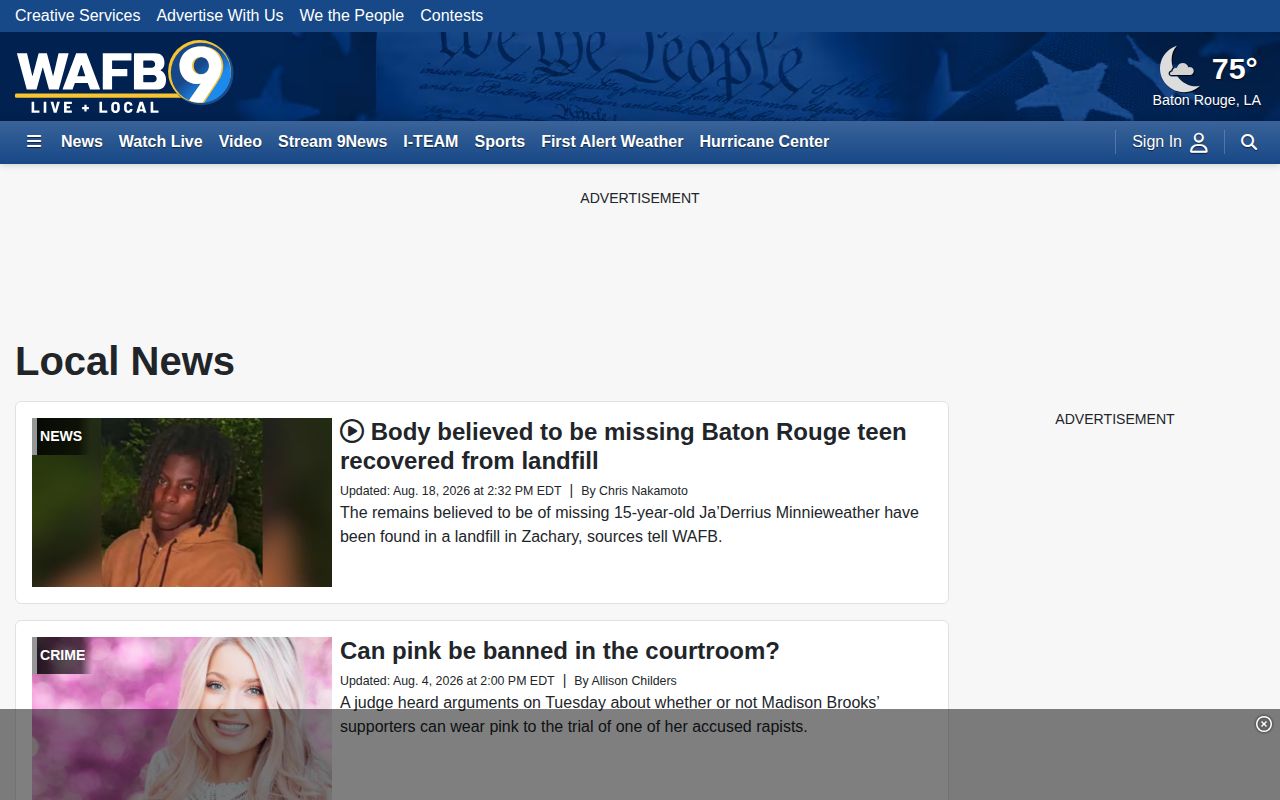
News coverage gives context, but it is selective. No outlet prints a full Ascension Parish arrest list. None of it replaces the government record itself.
A third-party date page earns its keep when the live roster no longer returns someone who has been released. Treat what you find there as a lead. Write down the publisher URL and the claimed booking date. Include the agency label and any booking number. Then run those details through APSO records and the court index. An aggregator's archive depth reflects what that publisher chose to collect, not the sheriff's retention schedule. A fat page count also cannot tell you how many distinct people were arrested. Reposts and repeat bookings pile up.
Recent Arrests by City
City police records and parish jail records answer different questions. The police department keeps its own incident or arrest report. APSO holds the jail booking. It is made when the person enters Ascension Parish Jail. Match the two through the arresting-agency field.
- Gonzales Recent Arrests: Gonzales Police Department records, APSO booking, and city news routes.
- Donaldsonville Recent Arrests: Donaldsonville Police Department, APSO District 1, and the parish jail in Donaldsonville.
- Sorrento Recent Arrests: Sorrento Police Department and town records, with the booking destination confirmed case by case.
A city arrest can become a filed court case. The right court source then carries the inquiry past the booking toward the official outcome.
Reading an Ascension Parish Arrest Record
A jail entry pulls together identity, custody, bond, and court-linking fields. Those fields mature at different speeds. A blank disposition on a fresh booking simply means the outcome has not been recorded yet. A scheduled release date is a projection, too.
- Name and descriptors
- Identity clues that should be matched with date of birth and record numbers.
- Booking and subject numbers
- The event identifier and APSO person identifier.
- Custody and housing
- Present jail status and assigned facility when populated.
- Booking photograph
- An identification image created after arrest or during custody.
- Charge, bond, and offense fields
- Charges and release-security data, not findings of guilt.
- Court and outcome fields
- The date, courtroom, docket, disposition, and sentence data that require court verification.
The APSO detail layout sets bond, charge, court, and disposition fields side by side. Read it as a staged record, not a basis for featuring or judging a person.
A few terms deserve care. An arraignment is the hearing where the court formally addresses a charge. A plea may be entered at that hearing. A disposition is the court's recorded result. A detainer is a request or authority from another agency seeking custody. It can affect release. An expungement removes qualifying material from public access under Louisiana procedure. Authorized justice agencies may still reach it. None of this can be read off a photograph. Trust the labeled field and the office behind it.
Released After an Ascension Arrest
Bonds in Ascension Parish are posted through the 23rd Judicial Court system, and APSO recognizes property, surety, and cash bonds. Bond is simply security tied to release conditions.
Once a person is released, the roster's default current-custody view may drop them. The booking still exists. The court case still matters. That shift is a custody transition, nothing more. Search by booking identifier and date, then follow the docket through the Clerk or the correct court.
Ascension Parish Mugshots After Arrest
The APSO roster shows booking photographs in its public result and detail views. A photo appears whenever one is on file. Louisiana Code of Criminal Procedure article 234 defines the image as one taken after arrest. The article also covers a person in custody. The roster publishes no guaranteed web-retention period. A photo's absence can reflect release, a portal rule, or a correction. Some other data change can explain it too.
Need a copy outside the live portal? APSO's written public-record route covers booking sheets and photograph pages, subject to lawful exemptions. The Louisiana Department of Public Safety & Corrections inmate-information route deals with state custody or supervision. It cannot substitute for every parish booking. Third-party photo pages are unofficial, often keep stale copies, and should never fill gaps in a record.
Some Ascension Arrest Records Stay Closed
Not every Ascension Parish arrest record is open. APSO's policy spells out the closed categories. Juvenile records are one. So is victim information in sexual-offense cases, along with confidential sources and undercover officers. Investigative and security material can stay closed too. Louisiana R.S. 14:133.7 separately protects confidential juvenile data and limits publication after an expungement or nondisclosure notice. A focused request helps the records custodian separate what can be released from what the law protects. If APSO denies part of a request, ask for the exemption and whether a redacted version exists.
Request an Ascension Arrest Record
APSO keeps its request process simple but mail-based. Put the request in writing and send it by USPS to Deputy Kyle Gautreau, Legal Affairs, APSO Headquarters, 828 S. Irma Boulevard, Gonzales, LA 70737. Describe the booking by name, date, and booking number. A broad request for every record tied to a name invites delay.
- Check the roster first and preserve the exact booking and subject numbers.
- Write a focused request for the booking sheet, photograph, incident record, or other identifiable item.
- Mail it to the named APSO records custodian; the policy does not provide an online submission route.
- Wait for the invoice and pay before release. The posted schedule is $1 per document page, $5 per photograph page, and $1 per minute plus $10 per disc for audio or video.
- If material is withheld, ask for the legal basis and pursue the court record separately when the requested fact is a disposition.
No fixed response time is published. Sealed or expunged records work differently. Article 971 pulls an expunged record from public view. It keeps access open to authorized criminal-justice users. Sometimes an unofficial site copies a wrong, outdated, or wrong-person entry. That publisher's own free correction channel is the fix. Send the record URL plus supporting documentation, and skip paid intermediaries. Cached search results can linger even after a publisher corrects an entry.
A booking sheet and an incident report differ. The booking sheet comes from the jail's booking process. The agency that made the arrest usually holds the incident report. Gonzales, Donaldsonville, or Sorrento police sometimes make that arrest. Name that agency in the request rather than assuming APSO owns the full narrative. APSO may still hold the jail record. The person was booked at the parish facility. Narrow wording cuts delay.
Keep a copy of the request and mailing date. Need only a photograph? Say so plainly, because APSO posts a separate per-page photograph charge. Ask for electronic delivery as a preference only, since the policy controls the format. A precise request also separates a missing record from an exempt one.
Which Ascension Arrest Court Applies?
Ascension arrest cases do not live in one database. The 23rd Judicial District Court, Ascension Parish Court, and municipal forums each can control a case. Jurisdiction decides which one. A booking page may list a court or docket number. That entry can also sit blank or carry only preliminary details. The Clerk's online index is not the official record. An item may simply not be indexed yet. When an online search comes up empty, use the court and docket from the booking. Then contact the responsible clerk. That fallback beats assuming an arrest has no case because a web index shows nothing.
Ascension Arrest Records Cross Locations
Ascension Parish Jail sits in Donaldsonville. APSO headquarters and the main business office are in Gonzales. The sheriff's patrol map splits east-bank and west-bank areas. So one Ascension arrest can touch four offices. A city police agency makes the arrest, the parish jail in another town books the person, and a separate court index tracks the case. Follow the record by function, not address. Ask the arresting department for its incident report, APSO for the booking sheet or photograph, Corrections for jail status, and the right clerk for the case outcome. Location alone never tells you who owns every part of the file.
Louisiana Arrest Records, Photos, and Retention
Louisiana R.S. 44:1 defines public records broadly. Photographs and electronic data fall inside that definition. Statutory exceptions still control access. C.Cr.P. article 228 requires prompt booking and lists the minimum booking-summary information, while juvenile, expunged, and investigative material can be withheld under the law that fits each record.
The Louisiana Legislature's current article 234 page is the authoritative text to review.
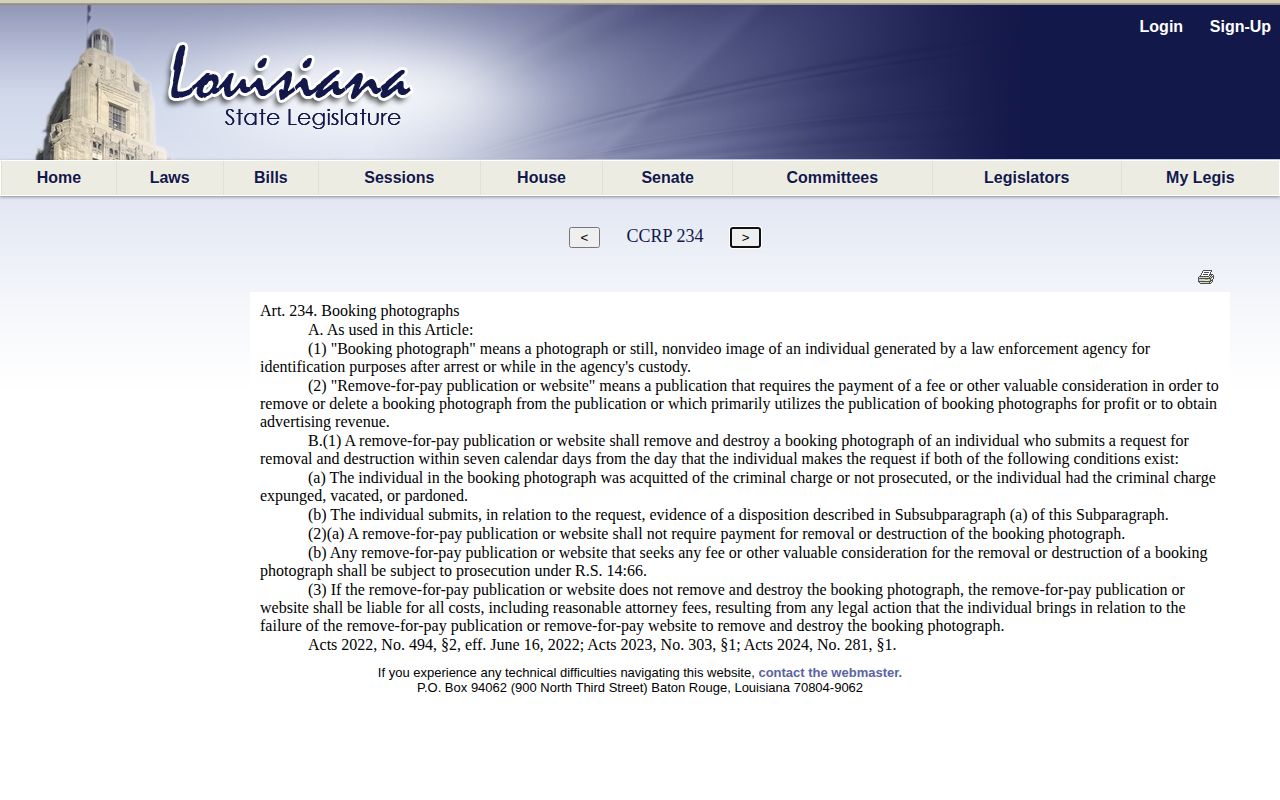
Read Louisiana's mugshot law in its current form. Older summaries floating around online are often out of date. Retention works differently from visibility. R.S. 44:36 sets a three-year minimum for records when no other period applies, which makes it a floor for records management rather than a promise that a booking stays on the roster. APSO, the Ascension Clerk, DPS&C, and the State Archives each hold different record series. Different schedules can govern each one. For older Ascension Parish arrest material, ask APSO for the applicable schedule and any transfer history. Give a date range and a record series.
The Louisiana State Archives requires agencies to inventory physical and electronic records, submit schedules for approval, and request disposal once the approved period ends. Photographs count as records. So do sound recordings and computer files. The State Archives lists no catalog entry for a routine current Ascension Parish booking-photo collection. An old jail image therefore should not be assumed to sit there by default. Ask the sheriff about booking sheets and images. Ask the Clerk about court series. Ask Archives staff whether a named series was ever transferred.
Portal visibility and legal retention are separate things. A roster page can disappear after release while the agency record survives, or it can vanish because of a redesign, a correction, or an outage. Only the custodian knows which. For an archival request, name the agency, the record series, the date range, and the medium, such as booking photographs or jail-management exports. That detail lets APSO or Archives staff locate a schedule, a disposal authorization, or a transfer history.
Ascension Parish Warrants and Wanted Notices
APSO runs a Warrants Division. It publishes no complete self-service warrant database. The public wanted list comes through Capital Region Crime Stoppers, a selective roster that may show a photo, charge, agency, and descriptors. That list is not exhaustive. Treat it as one window, not the whole picture. Worried about a warrant in your own name? Call APSO or a lawyer and get current official confirmation. Never approach, confront, warn, or try to detain a wanted person.
Tips go to Crime Stoppers at 225-344-STOP, through the P3 Tips interface, by text to 847411, or through APSO Tips. These are tip channels, not custody searches. The APSO Warrants Division answers at 225-621-8308. The Donaldsonville Business Office also lists warrant service among its functions. Use that direct route for a personal concern. Status can change fast, so skip the undated social post or the copied third-party page. The P3 Tips source shows the anonymous reporting interface Crime Stoppers uses.

A wanted notice names a person sought by police in Ascension Parish. The safe move is passing information to the listed authority, never direct contact.
After an Arrest: Follow the Court Case
A jail record starts the public trail. It rarely finishes it. APSO may show a court date, courtroom, docket number, or a later disposition field. Save the docket number. Then check the Ascension Clerk's online index, keeping in mind the Clerk's warning that the web index is not official and can lag. The 23rd Judicial District Court holds criminal jurisdiction in Ascension Parish. Ascension Parish Court has its own.
The usual path runs from arrest to booking and photograph, then to an initial appearance, bond decisions, filing decisions, and final disposition. Those steps happen across offices. They move at different speeds too. A booking charge reflects what police recorded at intake. Prosecutors can change course, filing a different charge or none at all, and the court may ultimately record a plea, dismissal, acquittal, diversion, or sentence. That is why the final court record matters more than a stale booking label.
Bond can show up early. APSO accepts property, surety, and cash bonds through the judicial system, and the jail's detail view may list the type and amount. Those entries describe a release route. If a released person drops off the current roster, use the saved booking number to request the jail record and the docket number to track the case. Release and custody status shift with the court calendar. The docket is the thread to follow.
Why can the jail and court pages disagree? They track different stages and update on different schedules. Match the docket and booking identifiers first, then let the court's official record settle the legal outcome.
From Parish Jail to Other Custody Systems
Which system holds a person shapes where you search. An Ascension Parish arrest gets two identifiers inside the parish system: an APSO booking number and a subject number. Those numbers stay local. Once a state sentence or transfer happens, the Louisiana Department of Public Safety & Corrections inmate-information page becomes the better tool. Its phone locator sits at 225-383-4580. DPS&C can give a state location and release details, and it points to VINE, though a fresh parish arrest will not always appear there. Before reading anything into a booking photo, check the booking-photo explanation first.
Federal custody runs on its own identifiers. The Federal Bureau of Prisons locator reaches inmates held from 1982 onward, and it shows no booking photo to the public. Then there is the ICE Online Detainee Locator. It finds people in ICE custody, or in CBP custody past 48 hours, using an exact A-number or exact biographical details, with no public-photo guarantee either. A blank result in any one system proves nothing. The person may simply sit in a different custody layer.
For the state side of that map, the DPS&C inmate-information page lays out the scope and the locator routes.
Never mix identifiers across systems. The APSO booking or subject number, a court docket, a VINE record, a DPS&C number, a BOP register number, and an ICE A-number each belong to their own world. None of them swap.
When someone will not show up anywhere, start by guessing the stage. Brand new local intake? That is APSO territory. Release or transfer alerts run through VINE. A sentenced Louisiana prisoner falls to DPS&C, federal imprisonment to BOP, and qualifying immigration custody to ICE. Jot down each date and result as you go. That custody timeline beats treating every locator like it shares one population on one update schedule.
Ascension Parish Sheriff’s Office Location and Directions
Public Record Search
Sponsored Results